|
Synchrony in biological systems
Synchrony has been identified in many biological systems,
such as synchrony in circadian clock cells, firefly flash synchrony,
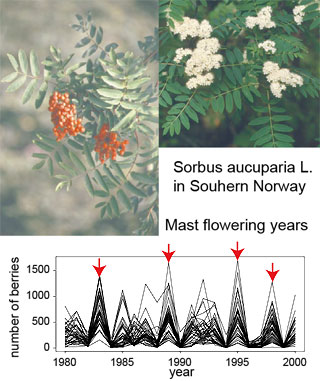
and synchronized decision-making in human societies. Synchronized flowering
in plant communities is an intensively studied phenomenon in ecology.
One well-known example is general flowering in South East Asia,
where more than 80 Dipterocarpaceae and other species flower synchronously
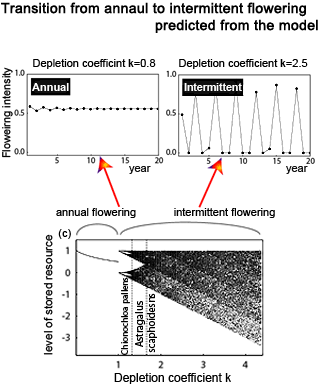
and supra-annually. We have developed a family of resource budget models,
categorized as coupled oscillator systems, and have explored the potential
mechanism of reproductive synchrony in plant populations.
Recent rapid progress in genetic and molecular analyses has provided
the genetic description of well-established flowering pathways in model plants.
For in-depth understanding of the mechanism of reproductive synchrony,
we are currently developing a gene regulatory network model of flowering time
control by integrating knowledge from ecological and molecular studies.
Some publications
- Satake A, Bjørnstad ON, Kobro S (2004) Masting and trophic cascades:
interplay between rowan trees, apple fruit moth, and their parasitoid in southern Norway. Oikos 104, 540-550
- Satake A, Iwasa Y (2002) The synchronized and intermittent reproduction of forest trees
is mediated by the Moran effect, only in association with pollen coupling.
Journal of Ecology 90, 830-838
- Satake A, Iwasa Y (2002) Spatially limited pollen exchange and a long-range synchronization
of trees. Ecology 83, 993-1005
- Satake A, Iwasa Y (2000) Pollen-coupling of forest trees: forming synchronized and periodic
reproduction out of chaos. Journal of Theoretical Biology 203, 63-84
|
|
Plants-pollinators network model
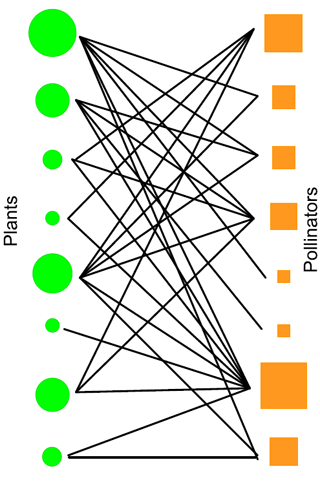
The architecture of plant-pollinator interaction influences
flowering phenology of plant species. Pollinators are often
attracted to a given plant species only after a certain
threshold density of flowers are in bloom. In contrast,
a heavy bloom may satiate pollinators and may reduce a number of
visits per flower. Plant species sharing such pollinator may aggregate
flowering if co-flowering contribute to attract pollinators,
or may segregate flowering if co-flowering results in a competition for
pollination service. Thus, the direction and intensity of selection on phenology
is determined by the balance between facilitation and competition of pollination
within plant-pollinator networks. We develop a mathematical model to shed
light on the role of plant-pollinator interaction on shaping flowering phenology
at community level.
Reference
- Rathcke B (1983) Competition and facilitation among plants for pollination.
Pollination Biology (ed. L. Real), pp. 305-329. Academic Press, London
|
|
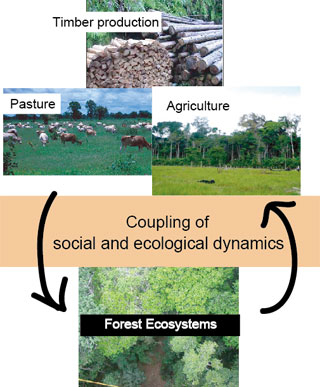
Coupled social and ecological systems
There is an increasing demand for studies on coupled social and ecological systems for solution of environmental problems. We are studying about models that couple ecological dynamics and human decision-making to provide unique insights and testable predictions towards successful management of ecosystems using Markov chain models, learning theory, and game theory.
Some publications
- Satake A, Levin SA, Iwasa Y (2008) Comparison between perfect information
and passive-adaptive social learning models of forest harvesting.
Theoretical Ecology (in press)
- Satake A, Rudel TM (2007) Modelling the forest transition: forest scarcity and
ecosystem service hypotheses. Ecological Applications 17, 2024-2036
- Satake A, Leslie HM, Levin SA, Iwasa Y (2007)
Coupled ecological-social dynamics in a forested landscape:
spatial interactions and information flow. Journal of Theoretical Biology 246, 695-707
- Satake A, Janssen MA, Levin SA, Iwasa Y (2007)
Collective deforestation induced by social learning under uncertainty
of forest-use value. Ecological Economics 63, 452-462
- Satake A (2007) The role of economic incentives and social norms in forest
resource management. Ecological Research 22, 21-22
|
| |
Group decision-making
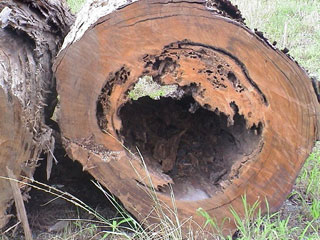
Bat societies represent one of the most sophisticated 'fission-fusion' systems:
social groups can divide into small parties with several individuals,
and social groups can fuse with other groups to form aggregation of larger number of
individuals. How and why the fission-fusion patterns emerge in bat populations
is still poorly understood. We are studying about an agent-based model for collective decision in bat populations to understand the mechanism of fission-fusion pattern.
|